General · Advanced
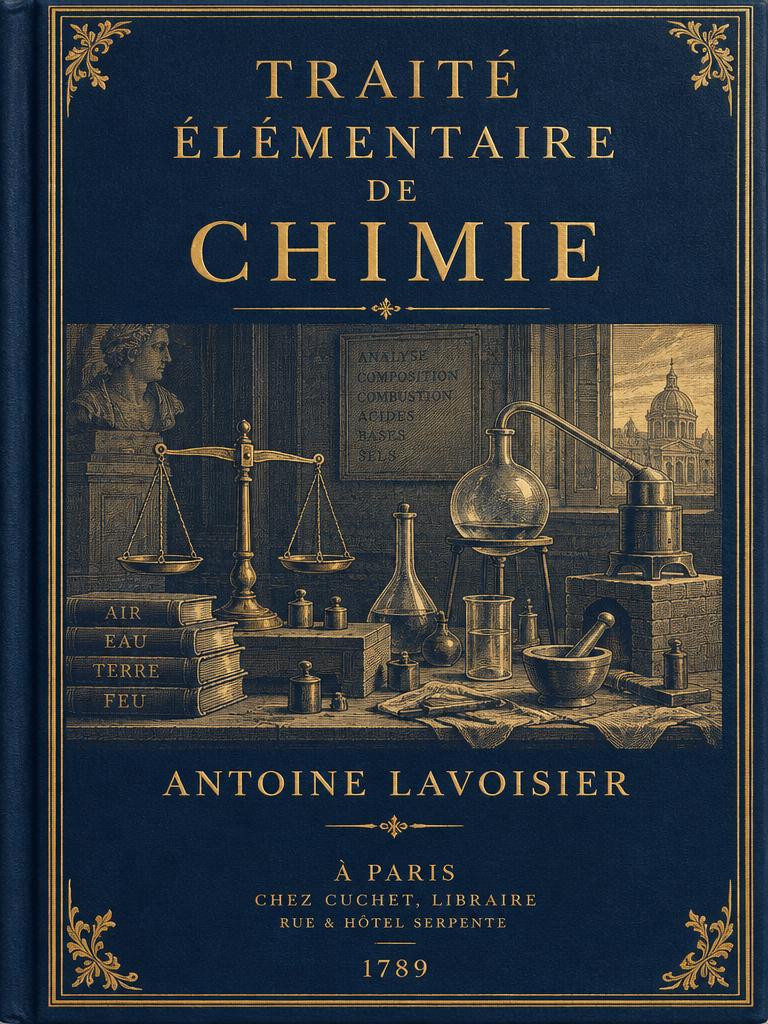
Traité élémentaire de chimie
Antoine Lavoisier · 1789
Considered the first modern chemistry textbook; introduced the conservation of mass and a new chemical nomenclature.
Inside the book
Antoine Lavoisier's 1789 Traité Élémentaire de Chimie (Elementary Treatise of Chemistry) is considered the first modern chemistry textbook. It consolidated the chemical revolution he led.
Key ideas covered:
• The law of conservation of mass — matter is neither created nor destroyed in chemical reactions.
• The rejection of the phlogiston theory and the correct oxygen-based theory of combustion and respiration.
• A new system of chemical nomenclature (with Guyton de Morveau, Berthollet and Fourcroy) — the origin of names like oxygen and hydrogen.
• The first modern list of elements, including oxygen, nitrogen, hydrogen, phosphorus, sulphur and many metals.
Why it matters: This book gave chemistry its language and its central quantitative law, earning Lavoisier the title "Father of Modern Chemistry".
Preface — Chemistry Needs a New Language
Lavoisier begins by arguing that the problem with chemistry is its vocabulary. Names like 'oil of vitriol', 'butter of antimony', 'flowers of zinc' and 'powder of algaroth' tell you nothing about what a substance contains, and often actively mislead — butter of antimony is neither butter nor pure antimony.
Working with Guyton de Morveau, Berthollet and Fourcroy, he proposes a systematic nomenclature: a compound is named after the elements in it, with endings that record how much oxygen is present. Oil of vitriol becomes sulphuric acid; its salts become sulphates. Less oxygenated forms take -ous and -ites: sulphurous acid, sulphites.
His claim is philosophical as well as practical. We cannot reason well with a bad language, because 'the art of reasoning is nothing more than a language well arranged'. Almost every compound name used in chemistry today descends from this system.
Part I, Chapters 1–3 — Gases, Heat and the Three States
Lavoisier explains the states of matter with a single idea: every substance can be solid, liquid or gas depending on how much caloric — the matter of heat — is combined with its particles. Add caloric to ice and you get water; add more and you get steam. The substance is unchanged; only its combination with caloric differs.
Caloric turned out not to exist, but the framework was enormously productive: it made gases ordinary chemical substances rather than mysterious 'airs', and it insisted that a gas has a definite chemical identity independent of its state.
He then analyses atmospheric air. By heating mercury in a sealed volume of air for twelve days he removes about one-fifth of it as red mercury calx; the remaining gas suffocates animals and extinguishes flames. Heating the calx returns exactly the gas that was removed, which supports both combustion and respiration vigorously. Air is therefore a mixture of two gases, not an element.
Part I, Chapters 4–8 — Combustion and the Death of Phlogiston
The reigning theory said burning bodies release phlogiston. Lavoisier's objection is quantitative: metals gain weight when they burn. If they were losing something, they should get lighter.
His alternative: combustion is combination with the oxygen portion of air. Burning phosphorus in a closed vessel consumes part of the air and the product weighs more than the phosphorus did — by exactly the weight of air lost. Burning charcoal gives fixed air (carbon dioxide). Burning inflammable air (hydrogen) gives water, which he demonstrates both by synthesis and by decomposing steam over red-hot iron.
Respiration, he shows, is slow combustion of the same kind: an animal in a sealed jar consumes oxygen and produces fixed air and heat, exactly as a candle does. Life and fire are the same chemistry running at different speeds.
Part I, Chapter 13 — Conservation of Mass
Here Lavoisier states the principle that makes chemistry quantitative: 'Nothing is created, either in the operations of art or in those of nature, and it may be laid down as a principle that in every operation there is an equal quantity of matter before and after the operation.'
He applies it to the fermentation of sugar. Weighing sugar, water and yeast before, and alcohol and carbonic acid after, he writes what is effectively the first chemical equation — must = alcohol + carbonic acid — and insists the elements must balance on both sides.
From this moment a chemical reaction is an accounting problem. If the books do not balance, something has escaped or entered unnoticed, and the chemist's job is to find it. This single sentence is why chemistry became a science of the balance.
Part II & III — The Table of Simple Substances and the Instruments
Part II lists thirty-three 'simple substances': substances not decomposed by any known means — Boyle's definition finally put to work. Oxygen, hydrogen, nitrogen (azote), sulphur, phosphorus, carbon and the known metals are there. So are light and caloric, which are not elements, and several 'earths' (lime, magnesia, alumina, silica) that were later shown to be metal oxides. Getting some entries wrong matters less than the format: a public, testable list that anyone can correct.
Part III is a laboratory manual, illustrated by Marie-Anne Lavoisier's engravings: gasometers, pneumatic troughs, calorimeters, balances, and instructions on sealing joints and correcting for temperature and pressure. Lavoisier's message is that precision is not optional decoration — his conclusions stand or fall on weighings, so the reader is shown exactly how those weighings were made.