General · Advanced
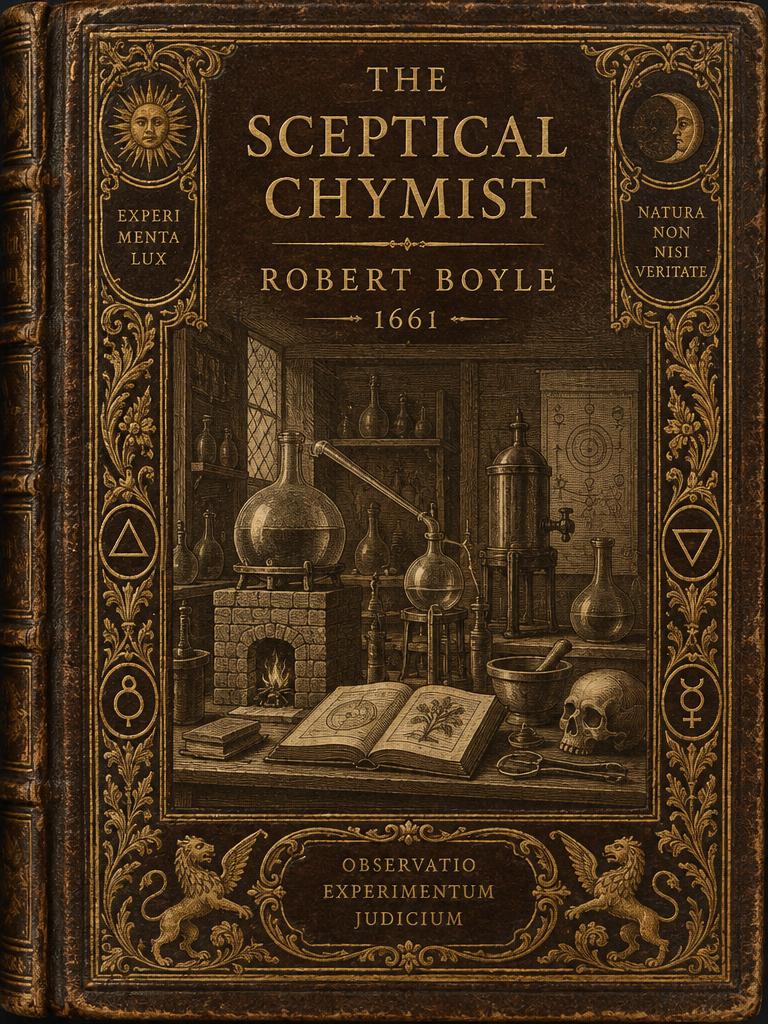
The Sceptical Chymist
Robert Boyle · 1661
Foundational text that broke with Aristotelian and alchemical traditions and argued chemistry should rest on experiment.
Inside the book
Published in 1661, Robert Boyle's The Sceptical Chymist is widely regarded as the founding text of modern chemistry. Written as a dialogue between several philosophers, Boyle attacks both the Aristotelian theory of four elements (earth, air, fire, water) and the Paracelsian idea of three principles (salt, sulphur, mercury).
Key ideas covered:
• The definition of an element as a substance that cannot be broken down into simpler bodies — the ancestor of our modern definition.
• The corpuscular philosophy: all matter is made of tiny particles whose arrangements explain chemical behaviour.
• A plea for careful experimentation over speculation, establishing chemistry as an experimental science rather than a branch of alchemy.
Why it matters: Boyle shifted chemistry from mystical alchemy toward measurement, reproducibility, and scepticism. Every chemistry student today works within the framework this book created.
Chapter 1 — The Setting: A Dialogue Among Friends
Boyle opens not with a lecture but with a conversation. Four friends — Carneades (Boyle's own voice), Themistius (who defends Aristotle), Philoponus (who defends the alchemists) and Eleutherius (the open-minded listener) — meet in a garden to settle an old quarrel: what are the true elements of which all bodies are made?
Themistius argues for the ancient four: earth, water, air and fire. Philoponus argues for the three Paracelsian principles: salt, sulphur and mercury. Carneades refuses both. His position is the heart of the book: no doctrine should be accepted because it is old or because a famous name taught it. It must survive experiment.
This framing matters more than any single result in the book. Boyle is insisting that chemistry is a branch of natural philosophy that answers to evidence, not a craft handed down as secret recipes.
Chapter 2 — Why Fire Is Not a Good Analyst
The standard proof of the four elements was simple: burn a green log. Water hisses out of the ends, smoke rises (air), flame appears (fire) and ash remains (earth). Therefore wood is made of four elements.
Carneades demolishes this. First, fire does not always give the same number of products — gold can be heated fiercely and yields nothing at all; it comes out of the furnace still gold. Second, fire sometimes creates new substances rather than separating existing ones: heat glass-makers' sand with alkali and you get glass, which was in neither ingredient. Third, the products of burning depend on how you burn: an open fire, a sealed vessel and a distillation flask give different results from the same material.
The conclusion is methodological and devastating: an instrument that gives different answers depending on how it is used cannot be trusted to reveal the ultimate composition of matter.
Chapter 3 — What an Element Actually Is
Having cleared the ground, Boyle gives the definition that chemistry still uses in spirit. Elements, he writes, are 'certain primitive and simple, or perfectly unmingled bodies; which not being made of any other bodies, or of one another, are the ingredients of which all those called perfectly mixt bodies are immediately compounded, and into which they are ultimately resolved.'
Three things are new here. An element is defined operationally — by what you can and cannot do to it in the laboratory, not by philosophy. The number of elements is left open; Boyle does not say there are four, or three, or any fixed count. And the definition is provisional: a substance counts as an element until someone succeeds in decomposing it.
That last point is why Boyle's definition survived. It allowed water to be an element in 1661 and to stop being one in 1783 without the definition itself failing.
Chapter 4 — Corpuscles: Matter Built from Particles
Boyle's positive theory is corpuscularianism. All matter consists of tiny particles — corpuscles — of one universal stuff, differing only in size, shape and motion. Corpuscles cluster into stable groups, and it is the arrangement of these clusters that gives a substance its colour, smell, solubility and chemical behaviour.
Chemical change, on this view, is rearrangement. Nothing is destroyed; particles are separated and recombined. This is why the same ingredients can yield different products under different conditions, and why a compound can be broken apart and put back together.
Boyle could not prove this, and his corpuscles are not Dalton's atoms — they have no fixed weights and no fixed combining ratios. But the picture of chemistry as the rearrangement of persistent particles is the one the science eventually adopted.
Chapter 5 — The Legacy of Scepticism
The Sceptical Chymist proves no new law and discovers no new substance. Its importance is that it changes what counts as a chemical argument.
After Boyle, an appeal to Aristotle or Paracelsus is not evidence. Claims must be stated clearly enough to be tested, experiments must be described in enough detail that others can repeat them, and failures must be reported alongside successes. Boyle practised this himself: his published work includes experiments that did not work, which was almost unheard of.
It took another 128 years for Lavoisier to publish an actual list of elements meeting Boyle's definition. But every entry on that list, and on the periodic table that followed, rests on the standard Boyle set in this book: an element is what you have not yet managed to take apart.