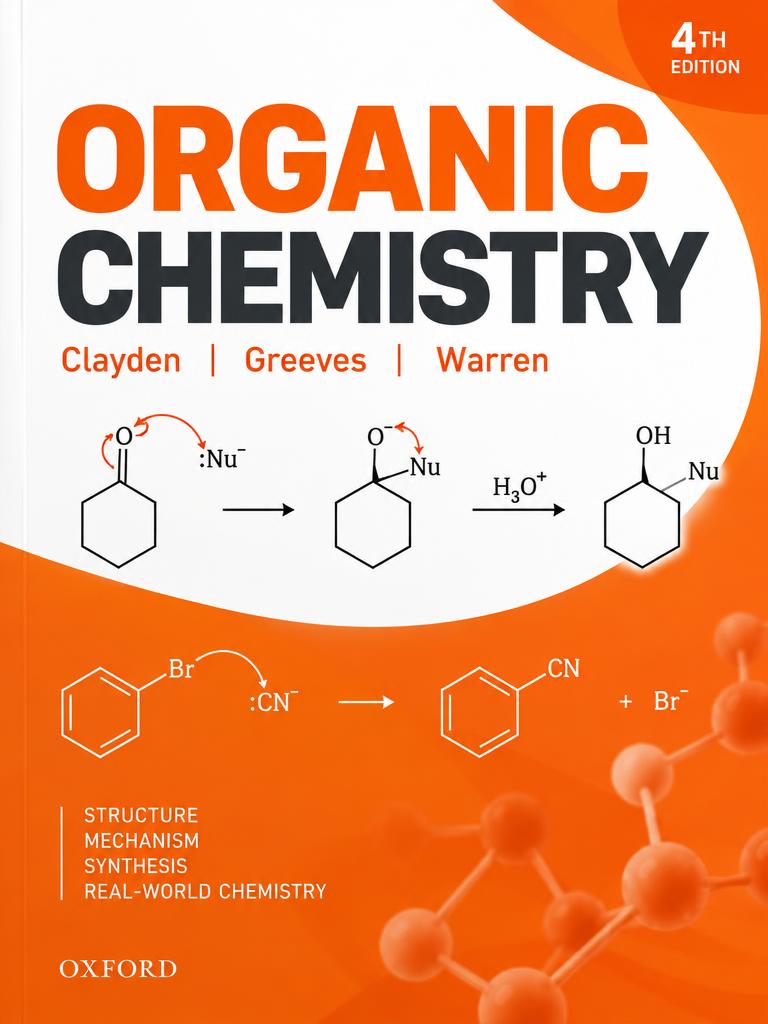
Organic · Undergraduate
Organic Chemistry
Jonathan Clayden, Nick Greeves, Stuart Warren · 2012
Modern, mechanism-first introduction to organic chemistry widely used in universities worldwide.
Inside the book
Clayden, Greeves and Warren's Organic Chemistry (2nd edition, 2012) is the modern standard for learning organic chemistry through mechanisms rather than memorisation.
Key ideas covered:
• Curly-arrow mechanism as the central language of organic chemistry — understanding why reactions happen.
• Structure and bonding, orbitals, and how molecular shape controls reactivity.
• Nucleophilic substitution, elimination, addition to carbonyls, enols and enolates, aromatic chemistry.
• Stereochemistry and conformational analysis — how 3D shape determines biological activity.
• Spectroscopy (NMR, IR, MS) as the detective toolkit for determining structures.
• Retrosynthetic analysis: planning the synthesis of complex molecules.
Why it matters: Its mechanism-first approach changed how organic chemistry is taught worldwide and remains the favourite of undergraduates everywhere.
Read the book — chapter by chapter
Chapter 1 — Curly Arrows: The Language of Mechanism
Clayden teaches organic chemistry as a set of reasons, not a list of reactions. A curly arrow shows a pair of electrons moving: it starts at a source of electrons (a lone pair or a bond) and ends where they form a new bond.
Every reaction is a nucleophile (electron-rich) attacking an electrophile (electron-poor). Once you can identify the highest-energy filled orbital of the nucleophile and the lowest-energy empty orbital of the electrophile, you can predict where a reaction will happen without memorising it.
Chapter 2 — Structure and Spectroscopy
Before predicting reactions you must know what a molecule looks like. The book introduces skeletal structures and the main tools to identify compounds: mass spectrometry gives molecular mass; infrared spectroscopy reveals functional groups such as C=O near 1700 cm⁻¹ and O–H near 3300 cm⁻¹; NMR spectroscopy shows how many kinds of hydrogen and carbon a molecule has and which atoms are neighbours.
The point is that structures are not guessed — they are determined from evidence.
Chapter 3 — The Carbonyl Group
The C=O group is the centre of organic chemistry. Oxygen is more electronegative than carbon, so the carbon is electrophilic and is attacked by nucleophiles: cyanide, hydride from NaBH₄, Grignard reagents and alcohols. Aldehydes and ketones undergo nucleophilic addition.
In carboxylic acid derivatives — acid chlorides, anhydrides, esters, amides — addition is followed by loss of a leaving group, giving nucleophilic substitution at the carbonyl. Reactivity follows leaving-group ability: acid chlorides react fastest, amides slowest.
Chapter 4 — Substitution, Elimination and Stereochemistry
At a saturated carbon, substitution occurs by SN2 — one step, backside attack, inversion of configuration — or SN1 — via a carbocation, favoured by tertiary carbons and polar solvents. Elimination (E1 and E2) competes and forms alkenes; strong bulky bases favour E2.
Molecules with a carbon bearing four different groups are chiral and exist as mirror-image enantiomers, named R or S. Since enzymes and drugs are chiral, controlling which enantiomer forms is one of the main goals of modern synthesis, covered in the book's later chapters on asymmetric synthesis.