Physical · Undergraduate
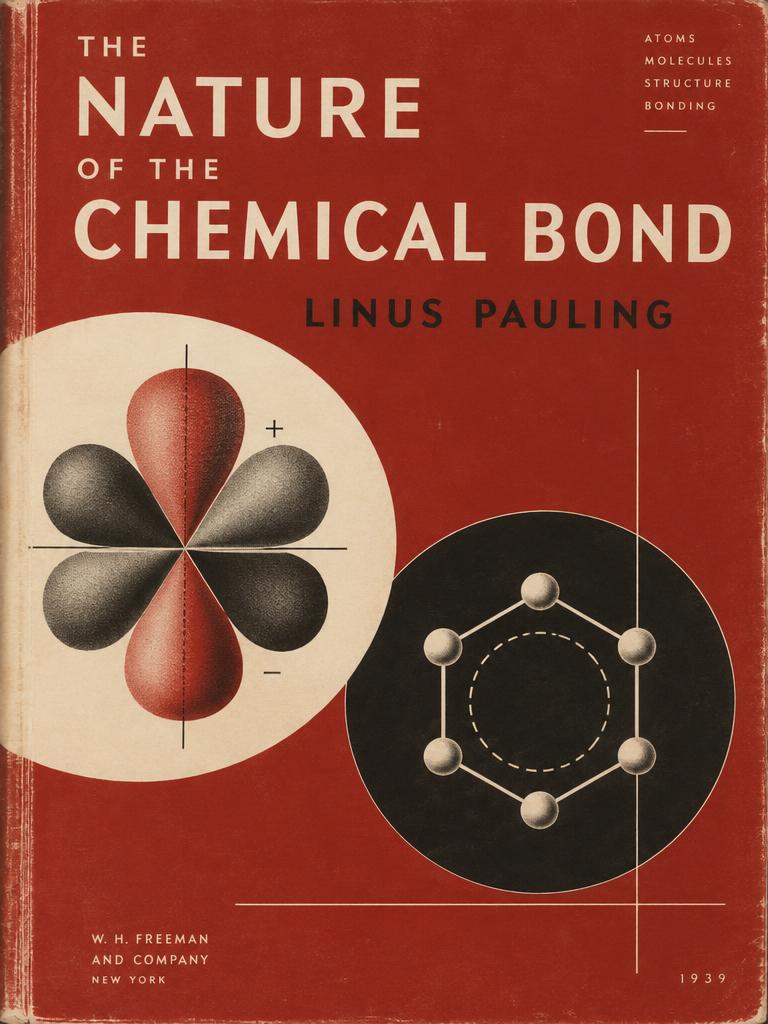
The Nature of the Chemical Bond
Linus Pauling · 1939
Pauling's synthesis of quantum mechanics and chemistry; one of the most cited science books of the 20th century.
Inside the book
Linus Pauling's The Nature of the Chemical Bond (1939) unified chemistry and quantum mechanics and became one of the most cited scientific books of the 20th century.
Key ideas covered:
• Valence-bond theory and the quantum mechanical explanation of the covalent bond.
• Electronegativity — Pauling's scale for predicting bond polarity, still taught in every introductory course.
• Resonance theory: molecules like benzene described as hybrids of contributing structures.
• Hydrogen bonding and its role in the structure of water, proteins and later DNA.
• The structures of complex crystals and molecules explained through bond lengths and angles.
Why it matters: Pauling's framework let chemists predict molecular structure and reactivity; it earned him the 1954 Nobel Prize in Chemistry.
Read the book — chapter by chapter
Chapter 1 — Types of Chemical Bonds
Pauling begins by distinguishing three ideal kinds of bond. In an ionic bond one atom gives electrons to another and the oppositely charged ions attract, as in sodium chloride. In a covalent bond two atoms share a pair of electrons, as in H₂ or Cl₂. In a metallic bond electrons are shared among many atoms at once.
Real bonds usually lie between these extremes. The book's central aim is to explain, using quantum mechanics, why a given pair of atoms forms the kind of bond it does and what that bond's length, strength and direction will be.
Chapter 2 — Electronegativity
Pauling noticed that a bond between two different atoms A and B is usually stronger than the average of the A–A and B–B bonds. The extra energy comes from partial ionic character: one atom pulls the shared electrons toward itself.
From these extra energies he built the electronegativity scale. Fluorine is most electronegative (4.0), followed by oxygen (3.5) and nitrogen (3.0); caesium is among the least. The difference in electronegativity between two atoms predicts how polar their bond is. Every chemistry student still uses the Pauling scale.
Chapter 3 — Hybrid Orbitals and Molecular Shape
Carbon has electrons in one 2s and three 2p orbitals, yet methane has four identical bonds pointing to the corners of a tetrahedron at 109.5°. Pauling explained this by hybridisation: the s and p orbitals mix to form four equivalent sp³ orbitals.
Other mixtures give other shapes: sp² gives the flat 120° geometry of ethylene and benzene; sp gives the straight line of acetylene. With d orbitals included, hybridisation explains the octahedral and square-planar shapes of many metal complexes. Shape follows from the orbitals used.
Chapter 4 — Resonance and Hydrogen Bonds
Some molecules cannot be described by a single bond diagram. Benzene can be drawn with alternating double bonds in two ways; the real molecule is a resonance hybrid of both, with all six C–C bonds identical and extra stability. Pauling used resonance to explain the planar, rigid peptide bond in proteins.
He also gave a full account of the hydrogen bond — a weak attraction between a hydrogen atom on N or O and another electronegative atom. It explains why water boils so high and ice floats, and it is what holds protein helices and the two strands of DNA together. These ideas led directly to his discovery of the alpha-helix in 1951.