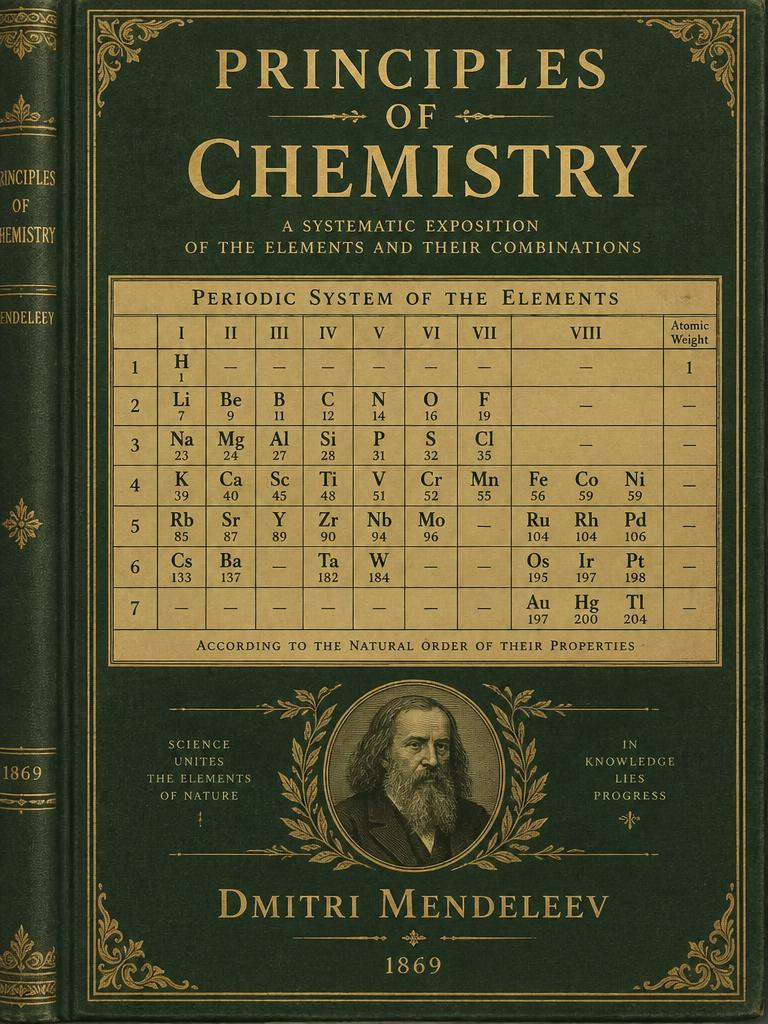
Inorganic · Undergraduate
Principles of Chemistry
Dmitri Mendeleev · 1869
Mendeleev's landmark textbook that introduced the Periodic Law to a generation of chemists.
Inside the book
Dmitri Mendeleev's Principles of Chemistry (first published 1869–1871) is the textbook in which he presented his periodic system of the elements to the world.
Key ideas covered:
• The periodic law: the properties of elements are a periodic function of their atomic weights.
• The first recognisable periodic table, arranging 63 known elements into groups with similar properties.
• Bold predictions of undiscovered elements — eka-aluminium (gallium), eka-boron (scandium) and eka-silicon (germanium) — with remarkably accurate predicted properties.
• Corrections of accepted atomic weights (e.g. beryllium, uranium) based on where elements ought to sit in the table.
Why it matters: The periodic table remains the single most important organising idea in chemistry, and this book is its birthplace.
Chapter 1 — Why Chemistry Needs a System
Mendeleev wrote Principles of Chemistry as a textbook for his students in St Petersburg. By the 1860s sixty-three elements were known, each with its own list of properties, and students had to memorise them one by one. Mendeleev wanted an organising principle that would let a student reason about an element instead of memorising it.
He chose atomic weight as the key quantity, because it was the one property every element had that could be measured precisely. His question was simple: if the elements are arranged by atomic weight, do their chemical properties show a pattern?
Chapter 2 — The Periodic Law
Arranged by increasing atomic weight, the elements show properties that repeat at regular intervals. Lithium, sodium and potassium are soft, reactive metals forming similar compounds; fluorine, chlorine, bromine and iodine form another family. Mendeleev stated the periodic law: the properties of the elements are a periodic function of their atomic weights.
He placed families in vertical groups and showed that valence — how many atoms of hydrogen or oxygen an element combines with — rises and falls across each row in a regular way. The table was not a decoration; it was a tool for predicting formulas of compounds.
Chapter 3 — Gaps and Predictions
Mendeleev's boldest move was to leave empty spaces where no known element fitted. Instead of forcing elements into the wrong family, he said the missing ones had not yet been discovered, and predicted their properties from their neighbours.
For 'eka-silicon' he predicted an atomic weight near 72, density about 5.5, and a white oxide EsO₂. Germanium, found in 1886, has atomic weight 72.6, density 5.35 and oxide GeO₂. Gallium (eka-aluminium, 1875) and scandium (eka-boron, 1879) also matched his predictions. These successes convinced the scientific world.
He also corrected some accepted atomic weights — for beryllium, indium and uranium — because their properties did not fit where the old values placed them. Later measurements proved him right.
Chapter 4 — The Elements in Detail
Most of the book is a careful survey of the elements group by group: hydrogen and water, the halogens, oxygen and sulphur, nitrogen and phosphorus, carbon and silicon, then the metals. Each chapter discusses how the element occurs in nature, how it is extracted, its main compounds, and its industrial uses — Mendeleev was deeply interested in Russia's petroleum, soda and agricultural industries.
Throughout, he refers back to the periodic system to explain why an element behaves as it does. The lesson for the reader is that chemistry is not a catalogue but a connected structure. Today the table is ordered by atomic number rather than weight, but its shape is still Mendeleev's.