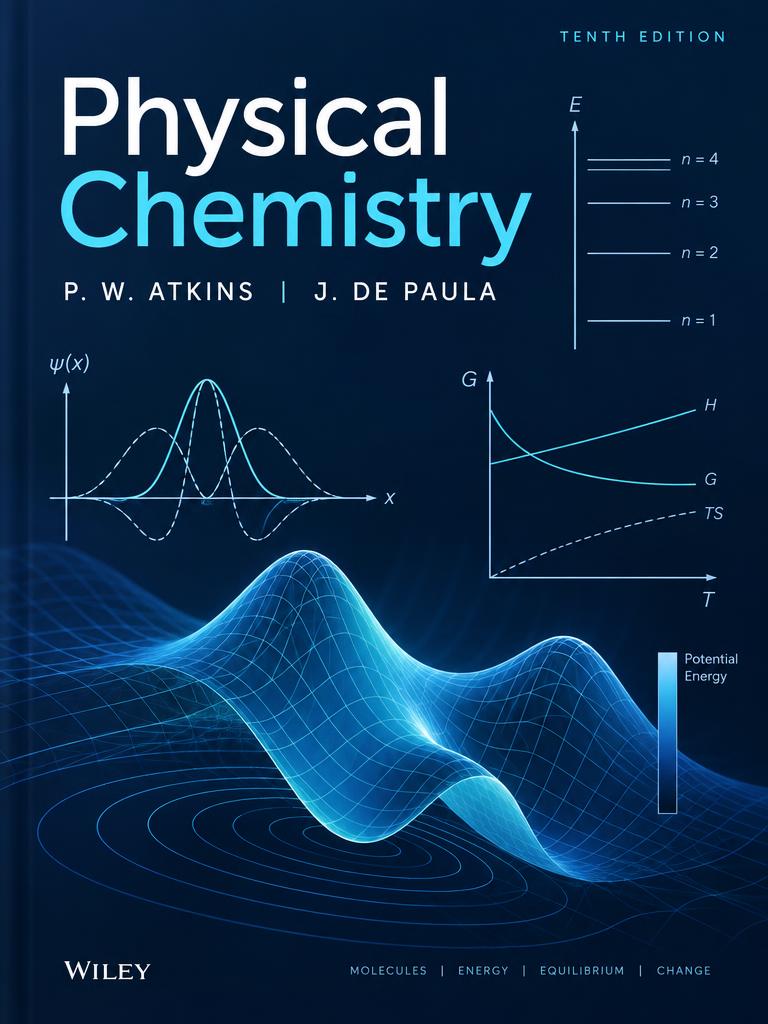
Physical · Undergraduate
Physical Chemistry
Peter Atkins, Julio de Paula · 2018
The classic undergraduate physical chemistry textbook covering thermodynamics, kinetics, and quantum chemistry.
Inside the book
Atkins and de Paula's Physical Chemistry (11th edition, 2018) is the classic text explaining the physical principles that underlie all of chemistry.
Key ideas covered:
• Thermodynamics: energy, entropy, free energy — the laws that decide which reactions can happen.
• Chemical kinetics: reaction rates, mechanisms, and catalysis.
• Quantum mechanics: the Schrödinger equation, atomic and molecular orbitals, and why bonds form.
• Spectroscopy: how light reveals the structure and motion of molecules.
• Statistical thermodynamics: connecting the behaviour of single molecules to bulk properties.
• Electrochemistry, surface chemistry and the properties of materials.
Why it matters: Physical chemistry is the "why" behind every other branch of chemistry, and Atkins has defined how it is taught for decades.
Read the book — chapter by chapter
Chapter 1 — Gases and the First Law
The perfect gas law pV = nRT describes ideal gases; the van der Waals equation corrects for molecular size and attraction. The kinetic theory explains pressure as molecular collisions.
The First Law says energy is conserved: ΔU = q + w. Enthalpy, H = U + pV, measures heat at constant pressure; Hess's law lets you calculate reaction enthalpies from tabulated values.
Chapter 2 — Entropy, Free Energy and Equilibrium
The Second Law says the entropy of the universe increases in any spontaneous change. Gibbs energy, G = H − TS, combines enthalpy and entropy: a reaction is spontaneous at constant T and p if ΔG < 0.
At equilibrium ΔG = 0, and ΔG° = −RT ln K links thermodynamics to the equilibrium constant. Le Chatelier's principle and the van 't Hoff equation explain how temperature and pressure shift equilibria.
Chapter 3 — Quantum Theory and Spectroscopy
Energy is quantised. The Schrödinger equation, solved for the particle in a box, harmonic oscillator and hydrogen atom, explains discrete energy levels and atomic orbitals.
Spectroscopy measures transitions between those levels: microwaves probe rotations, infrared probes vibrations, UV-visible light probes electronic transitions, and radio waves in a magnetic field probe nuclear spins (NMR).
Chapter 4 — Chemical Kinetics
Rate laws such as rate = k[A]ᵐ[B]ⁿ are found experimentally. First-order reactions have a constant half-life, t½ = ln2/k. The Arrhenius equation, k = A e^(−Ea/RT), shows how rate rises with temperature.
Reaction mechanisms are built from elementary steps, analysed with the steady-state approximation. Collision theory and transition-state theory explain rates at the molecular level, and catalysts speed reactions by providing a lower-energy pathway.